S&P 500 — US Large Cap Index
 FTSE 100 — UK Blue Chips
 Euro Stoxx 50 — Eurozone Leaders
 DAX 40 — German Equities
 CAC 40 — French Market Index
 Nikkei 225 — Japan Benchmark
 Hang Seng — Hong Kong Index
 Shanghai Composite — China Mainland
 ASX 200 — Australian Market
 TSX Composite — Canada Index
 Nifty 50 — India Large Cap
 STI Index — Singapore Market
 KOSPI — South Korea Index
 Bovespa — Brazil Equities
 JSE Top 40 — South Africa Index
 IPC Index — Mexico Market


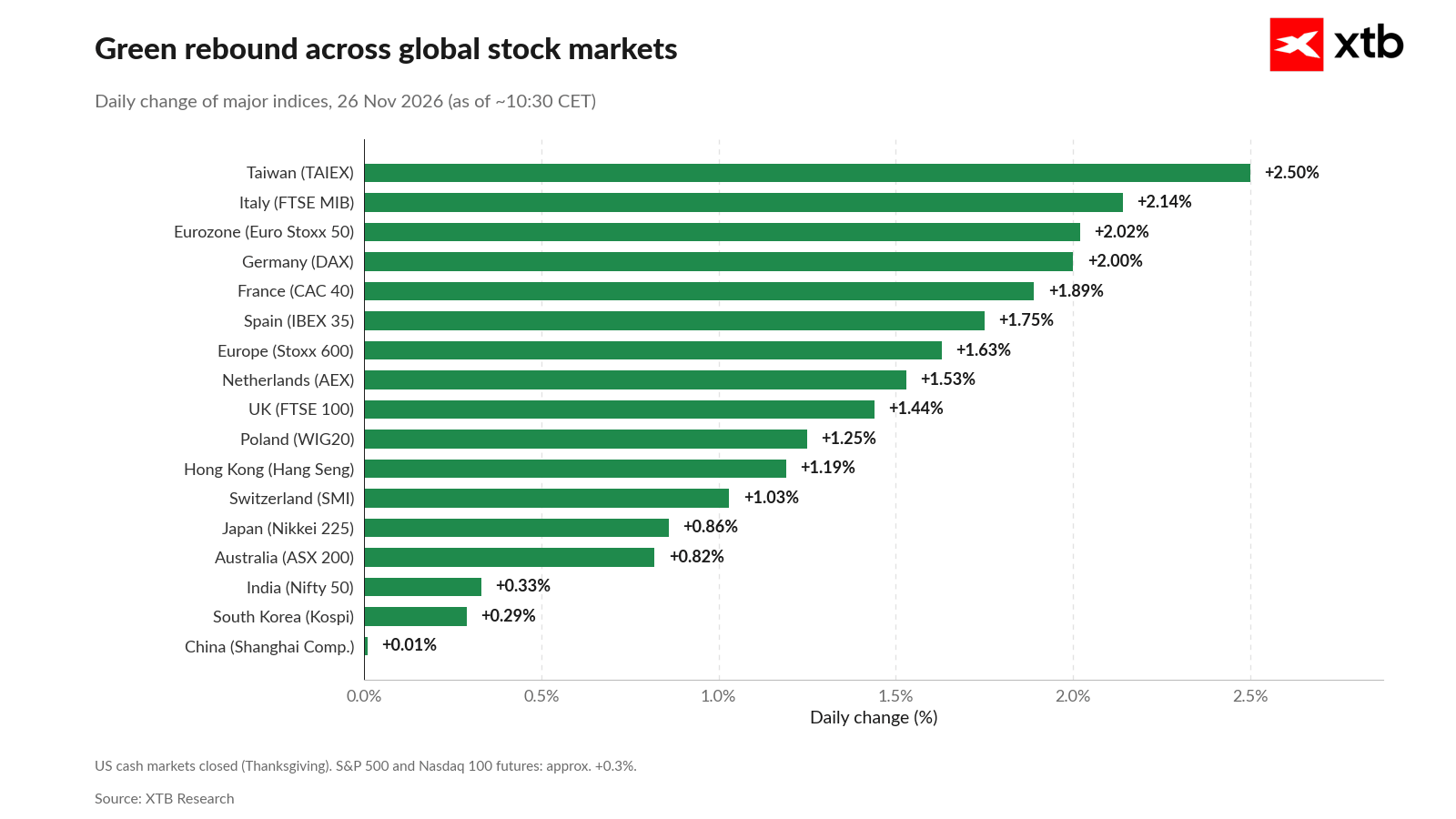
Buyers returned after Wednesday’s sell-off: the DAX and Euro Stoxx 50 are up around 2%, Taiwan +2.5%. Buyers returned to the markets following Wednesday’s sell-off. European indices are gaining up to around 2% today. The Euro Stoxx 50 is up 2.0%, the DAX is up 2.0%, Italy’s FTSE MIB is up 2.1%, and Spain’s IBEX is up 1.8%. The broader Stoxx 600 is adding 1.6%. In Asia, Taiwan was the strongest performer (+2.5%), while the Nikkei 225 gained 0.9% to close at 57,499 points. S&P 500 and Nasdaq 100 futures are up 0.3%. Wall Street will remain closed today for Thanksgiving.
Chart 1 shows today’s movements across global stock exchanges.
The rebound is driven by renewed demand for AI-related stocks. In Japan, Kioxia (+14%) and SoftBank (+12%) led the gains, with the bounce looking like a reaction to an excessive sell-off. Improving sentiment is also visible outside equities: copper rebounded more than 2% from an eleven-month low, and Bitcoin is rising for a second consecutive day. The argument for buying the dip is simple: AI spending remains high, financing is still available, and after the sell-off, tech valuations look even more attractive. It was sentiment that cracked, not fundamentals. However, it should be noted that today’s move looks more like a technical bounce than a lasting return of risk appetite. There is no shortage of reasons for caution.
The rebound occurred without any catalyst, and the expected US interest rate hike next month raises the cost of capital, creating a headwind for tech companies. Added to this are reports of halted Nvidia server shipments to Southeast Asia. New US tariffs, including 15% on goods from Korea, have taken a back seat today and are not dominating sentiment. Tariffs have faded into the background today, even though the scale of the move is significant.
The US announced another round of tariffs, justified by excess production capacity, which Washington says is the result of Chinese factories expanding abroad. Rates for South Korea are set at 15% and could rise to 25%. In Southeast Asia, they could reach up to 35% for Vietnam, 25% for India, and 20% for Singapore, though these countries have a chance to negotiate lower rates in talks with the US. China will pay an additional 20% on top of existing tariffs, and could face even higher rates if the trade truce breaks down. For now, investors are barely reacting, as negotiations are ongoing and the impact on supply chains will play out over time. The next test will come on Friday when trading resumes on Wall Street. That is when we will see whether the rebound has the strength to last.