S&P 500 — US Large Cap Index
 FTSE 100 — UK Blue Chips
 Euro Stoxx 50 — Eurozone Leaders
 DAX 40 — German Equities
 CAC 40 — French Market Index
 Nikkei 225 — Japan Benchmark
 Hang Seng — Hong Kong Index
 Shanghai Composite — China Mainland
 ASX 200 — Australian Market
 TSX Composite — Canada Index
 Nifty 50 — India Large Cap
 STI Index — Singapore Market
 KOSPI — South Korea Index
 Bovespa — Brazil Equities
 JSE Top 40 — South Africa Index
 IPC Index — Mexico Market


Today Markets IQ – Weekly Market Review & Outlook | November 27 – December 4, 2026
Part One: The Market Post-Mortem – What Happened This Week?
Wall Street ended Friday’s shortened Thanksgiving trading session firmly higher, with all three major US indices recording gains for the week as investors returned to heavily discounted artificial intelligence and technology stocks.
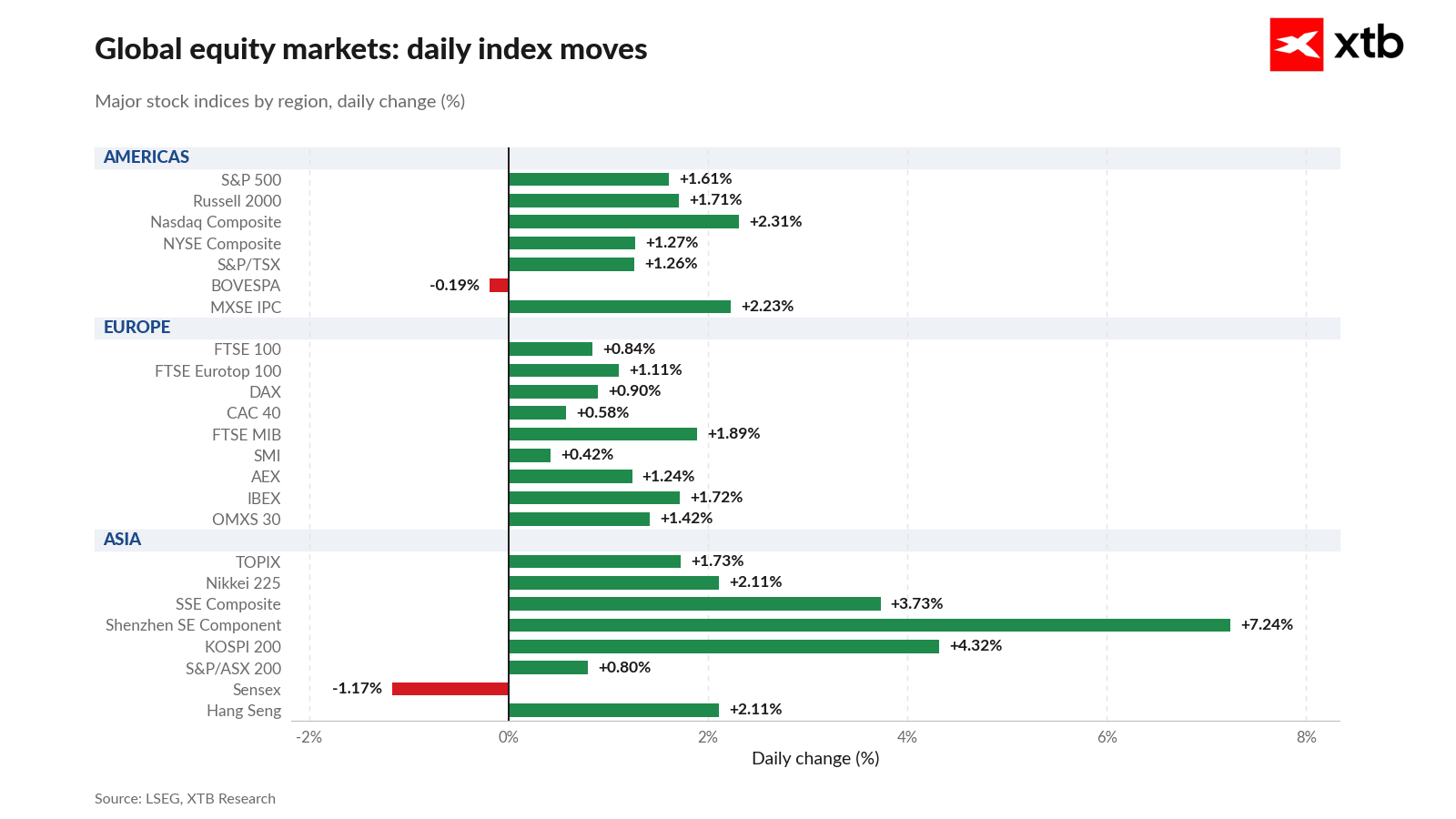
The Dow Jones Industrial Average (US30) advanced 1.19% to 50,781, while the S&P 500 gained 1.61% to close at 7,298. The Nasdaq Composite outperformed, rising 2.31% to finish at 24,130. London’s FTSE 100 also closed higher, adding 0.84%.
The recovery followed an exceptionally volatile week in which investors alternated between bargain hunting after a significant sell-off and concerns over rising AI investment costs, elevated technology-sector debt and uncertain returns from large-scale infrastructure spending.
Despite Friday’s gains, the broader November performance remains weak. The S&P 500 and Nasdaq are heading towards their worst November since 2008, reflecting persistent uncertainty surrounding technology valuations, potential regulatory changes and restrictive monetary policy.
Technology shares led Friday’s recovery, with semiconductor stocks and major AI-related companies attracting renewed buying. Nvidia, Tesla, Amazon and Meta all advanced, while Micron recorded a particularly strong gain.
However, the wider economic backdrop remains challenging. Recent US data indicated that third-quarter economic growth was considerably stronger than initially estimated, while inflation accelerated in October. Markets are consequently pricing in a high probability of a Federal Reserve rate increase in December.
Wall Street: Friday’s Closing Performance
| Market / Index | Friday’s close | Daily performance |
|---|---|---|
| Dow Jones (US30) | 50,781 | +1.19% |
| S&P 500 | 7,298 | +1.61% |
| Nasdaq Composite | 24,130 | +2.31% |
| FTSE 100 | — | +0.84% |
Technology and AI: Investors Return to Oversold Stocks
Technology and semiconductor companies were among the strongest performers as investors returned to areas of the market that had experienced significant selling pressure throughout November.
Micron and Marvell advanced, while the wider semiconductor sector also recovered, reflected in gains across the SOX index. Other companies associated with AI infrastructure and data-centre demand, including Sandisk, Lumentum and Dell, also moved higher.
The recovery extended to major hyperscalers operating large-scale data-centre infrastructure. Amazon, Microsoft, Meta and Oracle all benefited from improved sentiment. Tesla also recorded a strong advance.
| Company | Friday’s performance |
|---|---|
| Nvidia | +0.8% |
| Tesla | +5.2% |
| Amazon | +4.1% |
| Meta | +3.1% |
| Alphabet | +0.6% |
| Micron | +7.5% |
| AMD | +4.4% |
| TSMC | +3.5% |
Nvidia remained one of the most closely watched companies. Its share price had recently fallen approximately 38% from its October record high, bringing its forward price-to-earnings valuation down to levels not seen since 2018.
For some investors, the valuation adjustment suggests that the recent sell-off may have been excessive. Others remain concerned about supply-chain constraints, trade restrictions and uncertainty over the commercial returns from AI infrastructure investment.
The financial sector also performed strongly, with the S&P 500 banks index advancing. JPMorgan was a significant contributor, gaining 2.1%.
Macroeconomics: Inflation and Federal Reserve Expectations
Recent US economic releases showed that third-quarter GDP growth was significantly stronger than initially estimated, while inflation accelerated in October.
The combination of stronger economic activity and renewed inflation pressure has reinforced expectations that the Federal Reserve may maintain a restrictive policy stance.
Markets are now almost fully pricing in a December rate hike, according to the supplied market update.
In Europe, surprisingly low French inflation reinforced evidence that price pressures are easing. However, France’s GDP figures pointed towards weaker economic growth, adding to concerns over the country’s fiscal position and the broader European recovery.
The euro remained under pressure as softer inflation data reduced expectations of a more hawkish response from European central bankers.
Geopolitics: Black Sea Developments Influence Agricultural Markets
Ukraine’s proposal for a ceasefire in the Black Sea attracted market attention, raising expectations that important trade routes could potentially become more accessible and secure.
The development triggered a reaction in maritime freight rates and agricultural futures, including wheat and corn.
For agricultural markets, the potential restoration of more reliable shipping routes could influence export availability, freight costs and regional supply expectations. The longer-term impact will depend on whether diplomatic proposals translate into an effective agreement.
Commodities: Precious Metals and Copper Recover
Commodity markets delivered mixed performances on Friday, with precious metals and industrial metals recovering while energy prices moved lower.
| Commodity | Friday’s performance |
|---|---|
| Gold | +2.00% |
| Silver | Nearly +5.00% |
| Copper | More than +3.00% |
| WTI crude oil | -2.20% |
| Brent crude oil | -1.42% |
| European natural gas | -3.82% |
| US natural gas | -2.64% |
Gold advanced approximately 2%, signalling a return of buying interest following its earlier sharp correction. Lower bond yields and a weaker US dollar supported the recovery.
Silver performed even more strongly, gaining nearly 5%, while copper surged more than 3%, marking its most significant daily price increase since January. Short-covering and hopes for Chinese stimulus helped improve sentiment towards industrial metals.
Energy markets moved in the opposite direction. European natural gas declined 3.82%, US natural gas fell 2.64%, WTI lost 2.20% and Brent declined 1.42%.
Currency Markets: Brazilian Real Delivers a Major Rally
The Brazilian real was one of the strongest performers in currency markets, appreciating by as much as 4.8% in one of its strongest sessions in recent years.
The rally followed President Luiz Inácio Lula da Silva’s decision to appoint former Bradesco executive Luiz Carlos Trabuco to a key economic portfolio.
Investors interpreted the appointment as a potential indication that the government intends to pursue a more pragmatic approach to fiscal management.
The announcement helped restore confidence in Brazilian assets after a period of pressure linked to concerns about government spending and public debt.
In Europe, the euro remained under pressure following weaker-than-expected French inflation, which reduced expectations of further hawkish action from European central bankers.
Part Two: The Week Ahead – November 30 to December 4
The coming week brings several major catalysts capable of influencing global financial markets, including Sunday’s OPEC+ meeting, US manufacturing and services ISM surveys, Eurozone inflation and Friday’s US employment report.
Investors will also be monitoring the sustainability of the AI recovery, developments surrounding Nvidia and the continuing strength of the US dollar.
Three markets deserve particular attention: Oil, the S&P 500 (US500) and USD/JPY.
1. Oil – OPEC+ Decision and Saudi Attacks Keep Geopolitical Risk Elevated
Brent crude is trading around $90 per barrel and is heading towards its first weekly gain in November after three consecutive weeks of declines.
The recovery has been supported by renewed concerns over Middle Eastern energy infrastructure following attacks attributed to Yemen’s Houthi movement.
Saudi Aramco’s refinery in Jazan partially suspended operations after being hit by a missile, while the Houthis had attacked Ras Tanura a day earlier. Ras Tanura is one of Saudi Arabia’s largest refineries and an important oil export facility.
The security situation has also raised concerns over shipping through the Strait of Hormuz. According to the supplied market commentary, UOB analysts reported that Iranian attacks on tankers in the strategic waterway occurred approximately once a day during November.
However, the upside remains constrained by relatively high Middle Eastern exports and growing concerns about a global supply surplus.
The key event: Sunday’s OPEC+ meeting. According to Reuters sources cited in the supplied update, the group is expected to maintain existing production limits during the first quarter of 2027. Iraq is negotiating for a higher production quota, while reports suggest that the US administration has encouraged Iraq and Venezuela to consider leaving OPEC.
Wednesday’s US EIA crude inventory report, scheduled for 16:30, will provide another important market catalyst.
Bullish factors
- Further attacks on Saudi infrastructure or Gulf shipping routes.
- Continued OPEC+ production restraint.
- Unexpected geopolitical escalation.
- Concerns over the reliability of regional exports.
Bearish factors
- High Middle Eastern export volumes.
- Expectations of a global supply surplus.
- OPEC+ maintaining its existing policy without additional restrictions.
- Reduced geopolitical tensions.
Outlook: Oil’s direction will depend on the balance between geopolitical risk and underlying supply conditions. An unexpected OPEC+ decision or further attacks on Gulf infrastructure could quickly push prices higher.
2. US500 – Wall Street Rebounds as Investors Return to AI Stocks
S&P 500 futures are trading around 7,280, recovering part of the losses recorded during the previous week’s six consecutive declining sessions.
The rebound has been supported by renewed buying in oversold technology and artificial intelligence stocks. However, concerns surrounding AI investment costs, corporate borrowing and the ability of technology companies to generate sufficient returns continue to influence valuations.
Nvidia remains a particular focus, with its shares still reported to be nearly 40% below their October record high.
Corporate earnings to watch:
- Tuesday – Marvell Technology: Consensus estimates point to earnings of $1.09 per share and revenue of approximately $3.16 billion. Its results will provide insight into demand for data-centre chips.
- Wednesday – Salesforce: Expected earnings of $3.44 per share on revenue of approximately $11.47 billion. Results could reveal how AI is influencing software business models and profitability.
US economic data:
- Tuesday: Manufacturing ISM, forecast 55.1 versus 55.5 previously.
- Thursday: Services ISM, forecast 54.5.
- Friday: Nonfarm payrolls, forecast 90,000 new jobs versus 165,000 previously, with unemployment expected at 4.1%.
Bullish factors
- Continued buying in oversold AI stocks.
- Strong Marvell and Salesforce earnings.
- Evidence that AI infrastructure spending is generating commercial returns.
- Softer employment data potentially easing monetary-policy concerns.
- Improving investor risk appetite.
Bearish factors
- Renewed concerns about AI investment costs and corporate debt.
- Disappointing technology earnings or guidance.
- Strong employment data reinforcing expectations of restrictive monetary policy.
- Continued uncertainty over technology valuations.
- Further deterioration in market sentiment.
Outlook: The equity rebound faces a significant test from corporate earnings and economic releases. The key question is whether investors are beginning a sustained recovery in technology shares or simply covering short positions following the recent sell-off.
3. USD/JPY – Yen Weakness Brings 160 Intervention Threshold Into Focus
USD/JPY is approaching the psychologically important 160 level, trading around 159.5 as the Japanese yen remains under pressure against the US dollar.
Improving global market sentiment has supported US Treasury yields, while expectations surrounding US monetary policy have contributed to continued dollar strength.
However, the yen’s weakness is creating increasing concern among Japanese authorities. Tokyo previously intervened in the foreign exchange market around the 160 level in July, with similar intervention episodes in 2022 and 2024.
At the same time, core inflation in Tokyo accelerated in November at its fastest pace in 16 months, strengthening expectations that the Bank of Japan could raise interest rates as early as December.
Tuesday’s Japanese unemployment rate, forecast at 2.4%, will provide another indication of domestic economic conditions. Friday’s US employment report will also be important for Treasury yields and Federal Reserve expectations.
Bullish factors
- Further increases in US Treasury yields.
- Hawkish Federal Reserve expectations.
- Continued dollar strength.
- Differences between US and Japanese monetary-policy expectations.
Bearish factors
- Intervention risk as USD/JPY approaches 160.
- Rising Japanese inflation.
- Hawkish Bank of Japan communication.
- Weaker US employment data.
- A rapid reversal in long-dollar positioning.
Outlook: The 160 level remains the most important near-term reference point. A sustained move above it could increase the risk of intervention, while stronger Japanese inflation or weaker US employment could support a yen recovery.
Key Economic Events: November 30 – December 4
| Day | Event | Markets to watch |
|---|---|---|
| Sunday, Nov 29 | OPEC+ meeting | Oil |
| Tuesday, Dec 1 | US manufacturing ISM | US500, USD |
| Tuesday, Dec 1 | Japanese unemployment rate | JPY, USD/JPY |
| Tuesday, Dec 1 | Marvell earnings | Technology, AI stocks |
| Wednesday, Dec 2 | Salesforce earnings | Technology, US equities |
| Wednesday, Dec 2 | US EIA crude inventories, 16:30 | Oil |
| Thursday, Dec 3 | US services ISM | US500, USD |
| Friday, Dec 4 | US nonfarm payrolls | USD, USD/JPY, US500, gold |
| Throughout the week | Eurozone inflation | EUR, European bonds |
Overall Outlook: What Traders Should Watch
The week ahead will test whether the latest improvement in global risk appetite can develop into a more sustainable recovery.
Oil traders will focus on OPEC+ production policy and the potential for further disruption to Saudi energy infrastructure. The balance between geopolitical risk and expectations of a supply surplus will determine whether crude can extend its recovery.
For US equities, Marvell and Salesforce earnings will provide important insight into AI-related demand, while the ISM surveys and Friday’s employment report could influence expectations for Federal Reserve policy.
USD/JPY faces a particularly sensitive technical and political environment as the pair approaches 160. Strong US yields may continue to support the dollar, but intervention concerns and rising Japanese inflation could create significant downside risks.
Precious metals will also remain important to monitor following Friday’s recovery, particularly if US yields and the dollar begin to weaken.
The key theme for the coming week is whether improving sentiment can overcome persistent concerns about AI valuations, restrictive monetary policy and geopolitical risk. Oil, US500 and USD/JPY remain three of the most important markets to watch.
Today Markets IQ Analysis
This report is provided by Today Markets IQ, powered by Octalas Market Intelligence, with market commentary and research contributed by Currency Hedger.
Explore Our Services & Platforms
Free Multi Currency Account
Currency Hedger Signup
Free AI Market Analysis
Today Markets IQ Desktop
Deliverable FX Services
Visit Currency Hedger
Disclaimer: This material is provided for informational and educational purposes only and does not constitute investment advice, financial advice, trading recommendations or an offer to buy or sell any financial instrument. Financial markets involve risk, and past performance is not a reliable indicator of future results. Traders should conduct their own research and consider their financial circumstances before making investment decisions.